Tuesday, June 28, 2011

The Confederate Flag and Racism (or so you thought)


Long time ago we were told in school that the Union were the good guys and the Confederates were the bad guys.  Naturally, since the Union was fighting to keep slaves out of newly acquired territories, and the south feared that such government regulation meant that the slaves would be outlawed in their states as well, one would come to that conclusion.  First off, I'm glad the country is one and that slavery was abolished.  Slavery is one of the worst ways humans can treat other humans, however the Civil War wasn't fought to free the slaves in servitude at the time.  It was fought over outlawing slaves in the new territories.  That's not what I'm here to talk to you about.  What I'm here to talk about is the Confederate Flag being viewed as a racist symbol, and how that is completely and utterly incorrect, and how the school system has brainwashed the minds of millions into believing it.  History isn't so cut and dry, or black and white.  If it was, I wouldn't be interested in it.  Here's a little explanation for you:

First off, the "Confederate Flag" isn't the Confederate Flag.  The flag we know as the Confederate flag was actually the Battle Flag of the Army of Northern Virginia.  It was never adopted by the Confederacy.  In fact most regiments flew the flags that came from their state.  You may be asking yourself, "what's the difference?"  Here's the difference. 


Recognize this?  Probably not.  This is the first adopted National Flag of the Confederacy.  Now look at this one.


This is the flag the Union was using during the first part of the war.  They may not seem that similar, but read the accounts of the First Bull Run and see that there was confusion among the armies as to who's flag it was that they were shooting at.  You have to think about being shot at and trying to see through smoke to understand the mindset of those that were there.  Not only that, for generals who were watching from far away, the two flags looked the same and caused confusion among them when trying to issue orders.   In 1862, one year after the Civil War broke out, a new flag was being decided on by General Beauregard, the first general for the Confederates, who needed to design a new flag for the Army of Northern Virginia which was the primary force for the Confederates.  He needed a flag that looked completely different so that any confusion would be eliminated.  The flag he came up with is the flag we call the Confederate flag.  It was never adopted by the Confederacy, but used by many armies in the Confederacy with certain variations depending on the army.  The design had a couple of different meanings.  The meaning that I accept is that the 13 stars on the flag mean the 13 original colonies and that the blue "X" is actually on the stars.  This is their way of saying NO to the original colonies and that they reject the union and support forming their own country.  After the Civil War, the flag was adopted by the KKK and later by neo-Nazis to symbolize their racist cause, however the flag was never meant to represent racism, nor promote it. 


 Here's one thing to think about when seeing the "Confederate Flag" and viewing it as racist:


Recognize this?  This is our current US flag which has 50 stars.  I assume you all knew that.  Now, think about this. 1959 was when Hawaii became our 50th state.  1964 was when the Civil Rights Act was signed into law.  To be more exact, August 21, 1959 was when Hawaii came into the union.  The Civil Rights Act was enacted July 2, 1964.  The Civil War broke out on April 12, 1861 and ended on April 9, 1865.  How many years did the Civil War last?  3 days short of 4 years.  More importantly, how long did the Confederate flag exist?  About 3 years.  How long was our current flag, with all 50 stars, around before the Civil Rights Act was enacted.  4 years and around 11 months.  Almost 5 years of racism under our current flag, and yet it is the Confederate flag that is considered racist.  Wouldn't that, by these standards, mean that our current flag is a symbol of racism?  I truly believe that it isn't a racist symbol, but I'm merely pointing out the hypocrisy in that type of thinking.  Not only that, the flag we salute today, was the symbol of a nation that supported racism for longer than the entire Civil War.  I'll let you dwell on that. 
I'll also let you in on a little secret.  Abraham Lincoln passed the Emancipation Proclamation which, as we were taught in school, freed the slaves.  However, look closely at the document.  The document only outlawed slavery in the 10 states that were still in rebellion in 1863.  It didn't even apply to the 4 slave states that stayed with the union, nor did it apply to Tennessee who did secede from the union but was mainly under union control by 1863.  Tennessee was exempt from the proclamation.  Why is this interesting?  Because it was a political move on Lincoln's part.  Because those 10 states that were still in rebellion weren't controlled by Lincoln.  It was merely for show, and the union at the time ridiculed the act because it only applied to those states.  Slavery was still technically allowed in the northern states.  It wasn't until December of 1865, 8 months after the war, that slavery was finally abolished in the entire country.  The war didn't end slavery.  It ended secession.  In order for those 10 states to come back into the union, they had to agree to adopt the 13th Amendment.  Also, keep in mind that it was the North who demanded that each black/slave be counted as 3/5 of a person when it came to representation in the House of Representatives.  Race was never an issue before, during and for 100 years after, the Civil War.  So, while Lincoln may have attempted to end slavery, he never once, nor the federal government, attempted to end racism.  This is the reason I chuckle when I hear people say that Lincoln fought for the slaves.  According to history, not exactly.
In no way am I saying that I wish the Confederacy had won, or that racism should be allowed.  I know some who will read this post will believe that that is what I am saying.  Frankly, those people are too ignorant and closed-minded to be reading this blog anyway, and I don't need them.  I am reaching out to those who wish to expand their knowledge and understanding.  I commend you for taking the time. 
In the post before this one, I made the remark that people find history boring.  I found history interesting when I stirred the pot.  Made people feel uncomfortable.  People don't like to stray far from their comfort zone.  That area outside of the comfort zone is where I dwell.  I'm never satisfied with any answer given to me.  I need to know why and how. 
History has never been black and white, and it never will be.   Knowing all points of view, even if you go against the majority, will let you see through the wool that has purposely been pulled over your eyes.  Just because a certain view has the majority or is popular, doesn't make it right.  Before Civil Rights, the majority was racist towards blacks.  Were they right?  Who were the few that helped change it, and how long did it take? 


Friday, June 17, 2011

Americans Find History Boring? (Not Surprised)


It upsets me when I think about this.  A recent report came out stating that only 13% of high school seniors showed that they had a solid grasp of the subject.  As horrendous as that stat sounds, it is actually an improvement from 1994.  Some claim this poor score comes from a heavier emphasis on Math and Science due to the No Child Left Behind law, but I feel that it is something other than that.  I'm a historian, and more specifically, a military historian.  I've been this way since I was in the 4th grade watching my dad play war games on the tops of tables with miniature, hand-painted, soldiers.  The idea of this game caught my attention, so I strove to learn more about the different time periods.  Ancient Rome to the Seven Years War (French and Indian War in America), American Revolution, Napoleonic Era, WWII etc...  Why or how did I become interested in history?  Why is it so few feel the same way about history?  It's simple.
History is fascinating to me.  How many people enjoy listening to their older relatives telling stories about what they did as kids?  Why is it that only few of those enjoy history?  The answers I have are the curriculum, the textbooks, and the lack of caring.  Going through school, especially junior high and high school, history was taught in a boring manner.  Memorizing dates, people, and why certain things were important, was done in a boring fashion.  Think about it.  What do you know of WWII?  Hitler bad.  America good.  Japanese attacked us without us knowing.  The one question that is rarely taught in the schools is "Why?" Honestly, think about why WWII started.  Do you know why Hitler invaded Poland?  Do you know why Japan attacked us?  Do you know why the atomic bomb was dropped?  I can almost guarantee you that about 10% of people in this country would know the "true" answers to these questions.  We know that Hitler invaded Poland causing Britain and France to declare war on Germany.  We know that the Japanese attacked Pearl Harbor on December 7, 1941 to bring us into the war.  We know that we dropped two atomic bombs on Japan to bring the end of the war.  We know what, who, and where, but history is fascinating when you ask why.  I'll give an example.
1. Why did Hitler start WWII?
    Answer:  Would you believe that it is because of an event that happened 20 years before?  20 years before was the Treaty of Versailles which brought about the end of WWI.  Now to fully understand the answer, we need to know how WWI was started.  The Black Hand (a group of assassins from Serbia) was hired to assassinate Archduke Franz Ferdinand of Austria, who was heir to the throne of Austria, in an attempt to break off from Austria to form their own Slavic country.  The assassination was successful and what followed was the second deadliest conflict in Western history.  Austria declared war on Serbia in retaliation, causing Russia to decalre war on Austria, since Serbia was allied with Russia.  Germany declared war on Russia due to Germany being allied with Austria.  France was allied with Russia and therefore was at war with Germany by association, hence Germany declares war on France.  Germany then invaded Belgium, Luxembourg, and France in an attempt to take Paris.  End result was Germany and her allies being defeated.  At the Treaty of Versailles, Germany was blamed for starting the war.  You're probably asking yourself how, or why.  That's good if you are.  Austria declared war on Serbia, Russia declared war on Austria, then Germany declared war, yet they are blamed for starting the war.  They were an easy scapegoat.  An easy target.  The Austrian Empire didn't exist anymore.  Germany was next in line.  Germany was forced to reduce its military to 1,000 troops total.  They were not allowed to have a Navy, or Air Force.  They were also forced to pay war reparations, but the amount was never defined.  One year it would be a certain amount, but the next year it would be even more.  The following year would be more, and eventually Germany would be paying millions of dollars every year with no end in sight.  When Hitler came to power he demanded that money be printed in an effort to pay the amount demanded by the British and French.  Eventually, Germany went into a depression because of this.  Hitler decided to do away with the Treaty.  He started building up the military, including building ships and planes.  He was able to recruit people to follow him because they were just as tired of the Treaty as he was.  So because of the winning powers of WWI, WWII was fought which ended up being the bloodiest conflict in world history costing 60 million lives, and they built the foundation for one of the craziest people ever to gain power.  How many textbooks have told you this part of the story? 

That's my point.  Schools are set to only teach the same story over and over and over and over.  Would people be interested in math if the curriculum stayed on addition and subtraction through senior year in high school?  How about science?  Would it be interesting if you only learned about "water is a liquid and air is a gas" through senior year in high school?  Why is it that the material for every other subject evolves to keep up with maturing minds, yet the curriculum of history remains the same no matter what grade?  Granted the events, people, and dates don't change, but neither does 2+2.  Adding more to the story will make it more interesting.  Math evolves from learning basic addition and subtraction to Trigonometry.  Science evolves from learning the kingdoms of organisms, to physics and molecular biology etc...  History stays the same.  Fifth grade American history class:  American Revolution 1775-1783.  Ok.  Got that.  Eighth grade American history class teaches: American Revolution 1775-1783.  Got it.  Eleventh grade American history: American Revolution 1775-1783.  How about something with a little more detail or deeper understanding of the American Revolution.  What did it accomplish?  How was it fought?  How did it help George Washington become president?  No wonder it's boring for most people.  There's only so many times that you can be told that Hitler was bad, and he started WWII which was won because America entered the war and fought in France, marching their way to Berlin where the Nazis were eliminated and Hitler committed suicide.  Yeah.  You know the what.  You know the where, and who, but you weren't taught why.

Of course history isn't just wars, or military actions.  History is anything about how or why something came to be.  I recommend that everybody should pick a period of time that they find interesting and just go searching.  If you are a fan of Shakespeare, learn about the time period he lived.  If you like politics, learn how our system of government was formed.  If you like movies, learn how movies evolved.  It's all history.
I will say this, I had the oppotunity to march in the inaugural parade for Bush's second term.  I don't care what your politics are, or if you like him or not.  He was president for two terms, get over it.  Anyway, while in D.C. we were allowed to go visit the monuments and memorials.  This turned out to be history lessons from me to most of the marching band, (yes I was a band nerd), and some strangers who were merely passing by.  What I found interesting was that, for the most part people find history boring.  It's just memorizing dates, people, and events without application, yet for 2-3 hours I had the attention of everybody I was talking to.  I wasn't reteaching what they knew about a certain monument.  I was teaching additional information about the monument and showing how they could apply what they learned.  Little factoids that would only help you if you were on Jeopardy, but are still interesting to know.  An example would be that the Vietnam Wall is the only monument in D.C. that is black.  The reason being that the artist, who was female, wanted the wall to be black so it would show a reflection of you  looking at it.  It would make your reflection seem like the soul of one of those names on the wall.  It makes the wall seem alive.  Kinda like if the "soul" was staring back.  In the DVD made about our trip, unknown to me, there was an entire chapter dedicated to my tour of D.C.  Apparently my little tour was being filmed by a member of the band, but what I found fascinating was that I held the interest of everybody who was listening.  I gained that knowledge because I was always asking the questions of why and how. 
History isn't boring.  It can be if the same thing is taught numerous times over the course of a few years.  Instead of only memorizing who the Americans fought in the Revolution, or when and where, ask why.  You could also ask, why or how we won.  Farmers beat one of the most powerful armies in the world.  How or why?  History is only as interesting as you make it, same with being boring.  Pick something you are interested in, and learn how it came about.  You'd be surprised what you can dig up.  The information is out there. 


I've decided that I will use some posts for history lessons that will vary in time periods.  They will usually be about military history, but every now and then I will enlighten those who choose to listen, with things that have nothing to do with wars.

Monday, June 6, 2011

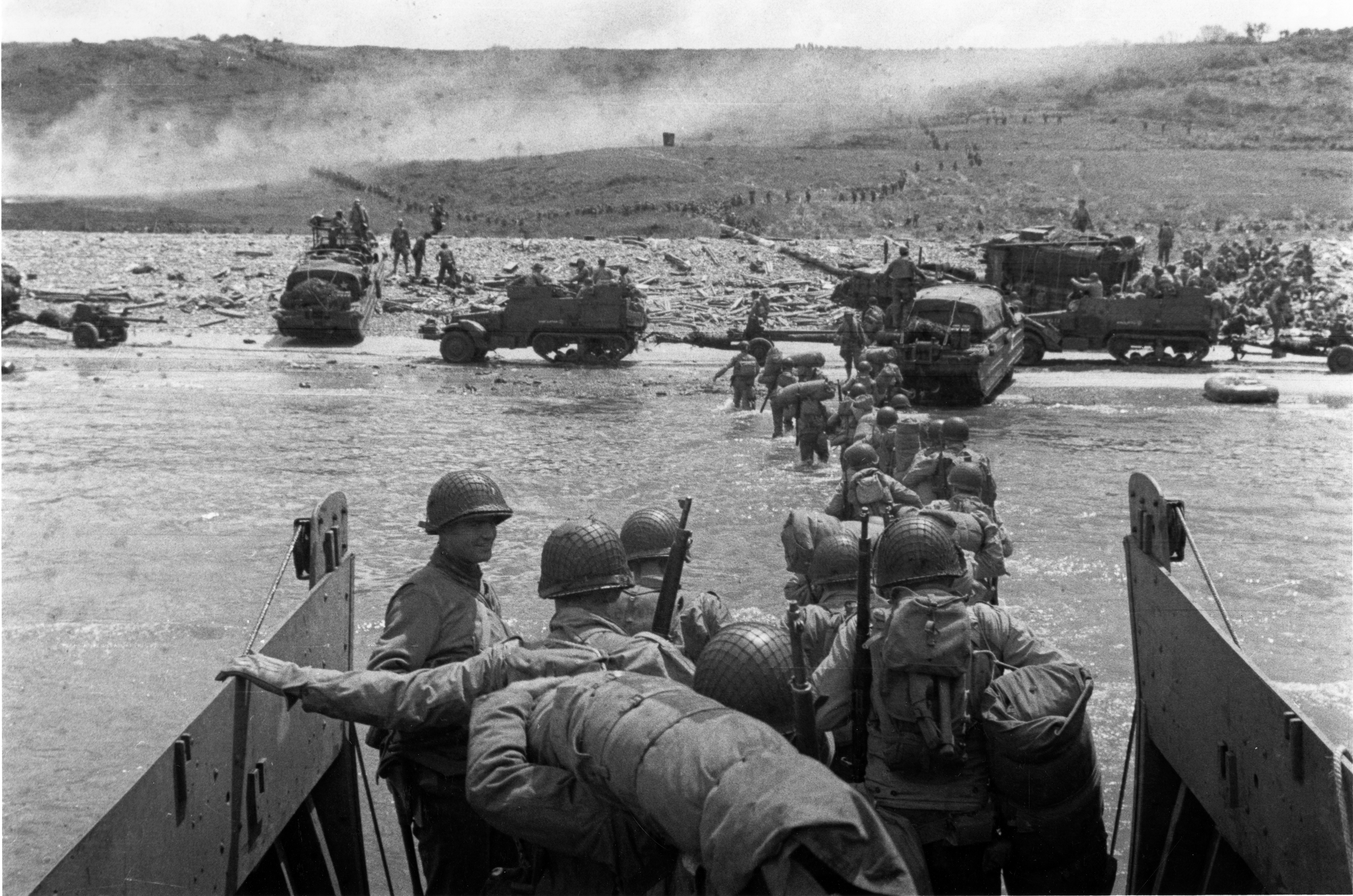
Remembering D-Day (June 6, 1944)

File:Omaha Beach Landing Craft.jpg


Sixty-seven years ago today, American, British, and Canadian forces stormed the beaches of Normandy in one of the biggest and most complicated invasions in history.  Seven years ago I had the privilege and honor of remembering those who had fallen, and honor those who were still alive that fought on that day.  On June 6, 2004 I accompanied our University's Band to Omaha Beach and performed at the ceremonies celebrating the 60th Anniversary of the D-Day invasion. 

 euro-t-guide.com euro-t-guide.com
The specific location we performed at was Pointe du Hoc (pictured above), which was where the Rangers scaled the 100ft cliffs, with ropes, while taking fire from the Germans on top.  Of the initial landing force of 225+ Rangers from the 2nd Ranger Battalion, only 90 survived the 2-day action.  The 5th Rangers were to land with the 2nd, but because of the delay of flares that were to signal the 5th Rangers to attack, they landed on Omaha Beach instead of Pointe du Hoc.  It is said that because of these added Rangers, a disastrous failure was averted. 
Pointe du Hoc is the same as it was 67 years ago, even though the artillery has been removed and the bunkers and pillboxes had the "windows" sealed up, but you can still walk inside them.  In 2004 we honored 9 of the Rangers who fought at that location, and I was blessed to have the opportunity to speak with them.  One Ranger was standing on top of a pillbox and was telling his story.  Apparently, that pillbox was one that he helped to clear out.  A woman asked him what it was like being there 60 years later.  He wept.  He stated that he couldn't understand why his life was spared.  Why he survived and many of his friends didn't even make it up the cliff.  I thanked him for his service, and my best friend and I did something that I will never forget.  Since Pointe du Hoc was left alone, the craters from the naval guns are still there (picture of person climbing out of one above).  My best friend was a marine and he wrote a message remembering and honoring those who died on that day, on his ceremonial cover ("Hat" for those who don't know) and we buried the cover in a crater.  I don't know if it is still there today, but I hope that it is, and I hope that it will remain there for all time. 
Being a military historian, standing on that ground was overwhelming.  It was the single greatest honor I've ever had, and at the same time, I was standing on ground that I consider sacred.  This was the ground where the world was saved.  Where the war changed.  Where our military stared adversity in the eye, and shoved it back with courage, ferocity, and blood.  Our tour bus took us to the cemetery that is seen in Saving Private Ryan, and you would be amazed as to how massive that place is.  They also opened up the path to the beach allowing us to run down the long winding path all the way to the sand.  At that moment, when my feet hit the sand, tears welled up in my eyes.  There is a sense of awe and glory when standing there.  To put yourself at that location 60 years before, is something that can't be explained. 
File:1944 NormandyLST.jpgThe men who died on that day sacrificed themselves to rid the world of tyranny and shall forever receive our gratitude.  The men who survived that day made it possible to carry on the mission of ending the war, and shall forever receive our gratitude now and after they have passed.  I will always remember, and I will never forget. 
  

Monday, April 18, 2011

The Last Generation

I've been giving this some thought and realized something a few months back.  I'm 27 years old and I realized that my generation was the last generation to experience toys that required an imagination, playground equipment that is now considered deadly, and Saturday morning cartoons.  Follow me on this:

TOYS: For those of you my age or older, remember the toys we had?  Remember getting an action figure out of the box that came with a ton of small parts that we could easily eat and swallow, but never attempted to, because plastic tastes like butt?  G.I. Joe's were awesome.  However, they always came with little plastic guns or helmets that today would require a warning label stating how it was a choking hazard.  Are kids today that hungry?  Also, remember how the action figures required you to make noises for fun, instead of always requiring batteries to produce the sounds for you?  Kids today don't have much of an imagination.  To put into perspective, I had all 4 of the Teenage Mutant Ninja Turtles, well my brother and I shared them, and they all came with their individual weapons, but were all colored the same light brown.  Well, we never had villains from the series as toys, but if you took Lazer Viper, from G.I. Joe, and took off the helmet and lazer backpack, he looked like an evil ninja.  I can't tell you how many times I had Michaelangelo do a roundhouse kick to the face, and not only that, GI Joe figures' heads moved.  The kick could be given hard enough to where the head would move with the kick and make it seem authentic.  Nowadays I see toys being sold that seem to take away the imagination required to play.  Maybe I'm overthinking some things, but it saddens me seeing kids not making sounds when playing with their toys.

Playground Equipment: When I was in grade school, our playground equipment was being transititioned into what the equipment is nowadays.  When I was in 6th grade, the slide was the twister-like plastic slide that gave you tons of static.  Before that, we had the metal slide that had a hump halfway down.  If you were going fast enough, that hump would send you sailing to the bottom, if you were light, or rolling head over heels to the not so soft gravel that awaited your arrival if you were fat.  Also, and this is for those who are too young to remember the metal slides, when the sun was out, that slide would bake in 1,000degree heat and would feel like it was taking the skin off of the back of your legs.  It didn't matter.  We all braved it.  We all went down the slide with shorts on and short sleeve shirts.  The most fun game was trying to run up the slide while someone was coming down.  Usually ended in someone, or both, going over the side to the 19ft drop below causing the back to be tore up from the gravel.  Remember the long ladders we had to climb?  It was a journey just to get to the top.  Swings back then were different.  They were wooden, sometimes plastic, planks that you sat on that didn't mold to your butt to keep you on them.  You held on by the rusty chains that kept the swing attached to the rest of the rig.

 I don't know if anybody else had this, but at my grade school we had this thing that was made out of wooden telephone poles.  Two pieces were in the ground that stood straight up and had two other pieces attached to it at an angle towards the ground.  At the top was a horizontal pole that attached the other 4 together.  See diagram at left.  On the part that was slanted there were truck tires arranged to allow people to climb at that angle to the top where the 4 pieces met and the part that was straight had rusty chain netting that let you climb to the top as well.  We played Cowboys and Indians on that thing.  The indians were supposed to climb the net and the cowboys were to lay down at the top and push the indians off.  If an indian got over the top, he was to push a cowboy through one of the tires which dropped down to an empty area behind the net.  This was the prison.  There wasn't any kind of gravel to break the falls, but there were rocks to ensure the maximum amount of pain was handed out.  I was always an indian, mainly because everyone knew that I was big enough to not get pushed off, but able to push others.  I was always the biggest kid.  This was what we called fun.  This is what we called a game. 

Saturday Morning Cartoons: For those of you, my age or older, you remember that whole week when we had to get up for school, it was like pulling teeth to get us out of bed by 7:00.  However, Saturday mornings, we were up at 5am, and we snuck downstairs so mom and dad wouldn't hear us, and we would pour the biggest bowl of cereal ever, and go and watch TV.  The shows my brother and I watched were Ghostbusters, Looney Tunes, Tom and Jerry, etc...  Afterwards was WWF.  Then Cartoon Network came into existence.  At first it was like, "THIS IS AWESOME.  I GET CARTOONS ALL OF THE TIME!!!!"  After a while it became boring.  Cartoons weren't special anymore.  There wasn't a reason to get up on Saturday mornings.  Needless to say I was about 10 years old when Cartoon Network came around.  Then I look at the animation of the cartoons for kids today.  Horrible, primitive, and no effort drawings.  Where are the cartoons that were drawn well?  What happened to those cartoons where the animators actually cared about what they were doing?  It sickens me and saddens me. 

I was part of the last generation who rode their bikes without helmets.  Remember a time where wearing a helmet got you teased or bullied?  Those kids were called pansy, girly, weakling, etc...  The only ones who were socially allowed to wear helmets were the skaters.  Anybody else, strictly forbidden. 

Anyway that's my rant for the day and hopefully those who are the same age or older remember what I'm talking about, and those who are too young to know, learned something.